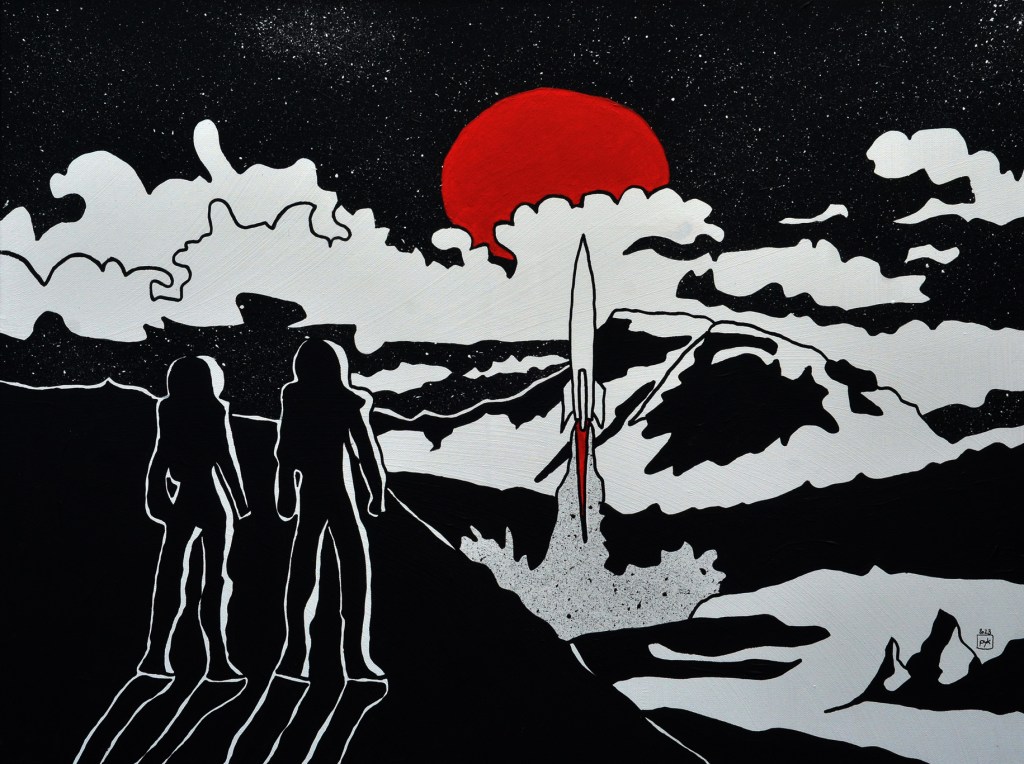
Départ pour la terre
Toile 60 x 80 cm
Peinture acrylique noire, blanche et rouge
Eté 2023
Exposée à l’atelier depuis juillet 2023
La colonisation de Proxima Centauri b a commencé. Contrairement aux premières estimations, la planète comporte bel et bien des terres émergées au niveau du terminateur. L’atmosphère épaisse protège la planète des rayonnements durs de sa naine rouge et permet l’agrandissement des régions habitables en opérant des transferts thermiques d’une face à l’autre de la planète.
Corolaire de ces conditions particulières ? Il est assez rare de voir le ciel étoilé depuis la colonie. Le tableau représente le départ de la navette pour la terre qui est toujours un moment particulier. Elle assure le contact régulier et le transfert des marchandises indigènes ver la planète mère située à environ 4,2 années lumières. Le ciel étoilé, signature de la série n’est que partiellement visible.
En 2023, les scientifiques estiment que la planète pourrait être visitée par le projet Breakthrough Starshot en seulement une vingtaine d’années après lancement des sondes. Ce projet lancé début 2016, a pour objectif d’envoyer des milliers de sondes spatiales d’environ 1 gramme, équipées de voiles solaires, vers Alpha du Centaure, le système stellaire le plus proche du système solaire. Le faible poids de ces sondes, allié à la puissance du laser terrestre utilisé pour les propulser jusqu’à 100 gigawatts, permettrait à ces dernières d’atteindre 20 % de la vitesse de la lumière dans le vide et ainsi de pouvoir nous retourner des images des exoplanètes potentielles d’Alpha du Centaure, notamment de Proxima Centauri b, d’ici 40 à 50 ans.
Leaving for the Earth
60 x 80 cm canvas
Black, white and red acrylic paint
Summer 2023
On display at the studio since July 2023
Colonization of Proxima Centauri b has begun. Contrary to initial estimates, the planet does indeed have land at the terminator. The thick atmosphere protects the planet from the harsh radiation of its red dwarf, and allows habitable regions to expand through heat transfer from one side of the planet to the other.
The corollary of these special conditions? It’s quite rare to see the starry sky from the colony. The picture shows the shuttle’s departure for Earth, which is always a special moment. It ensures regular contact and the transfer of native goods to the home planet some 4.2 light-years away. The starry sky, signature of the series, is only partially visible.
In 2023, scientists estimate that the planet could be visited by the Breakthrough Starshot project in just twenty years after probe launch. Launched in early 2016, this project aims to send thousands of space probes weighing around 1 gram, equipped with solar sails, to Alpha Centauri, the closest star system to the solar system. The low weight of these probes, combined with the power of the terrestrial laser used to propel them up to 100 gigawatts, would enable them to reach 20% of the speed of light in a vacuum, and thus be able to return images of potential exoplanets in Alpha Centauri, notably Proxima Centauri b, to us within 40 to 50 years
 Les peintures
Laisser un commentaire