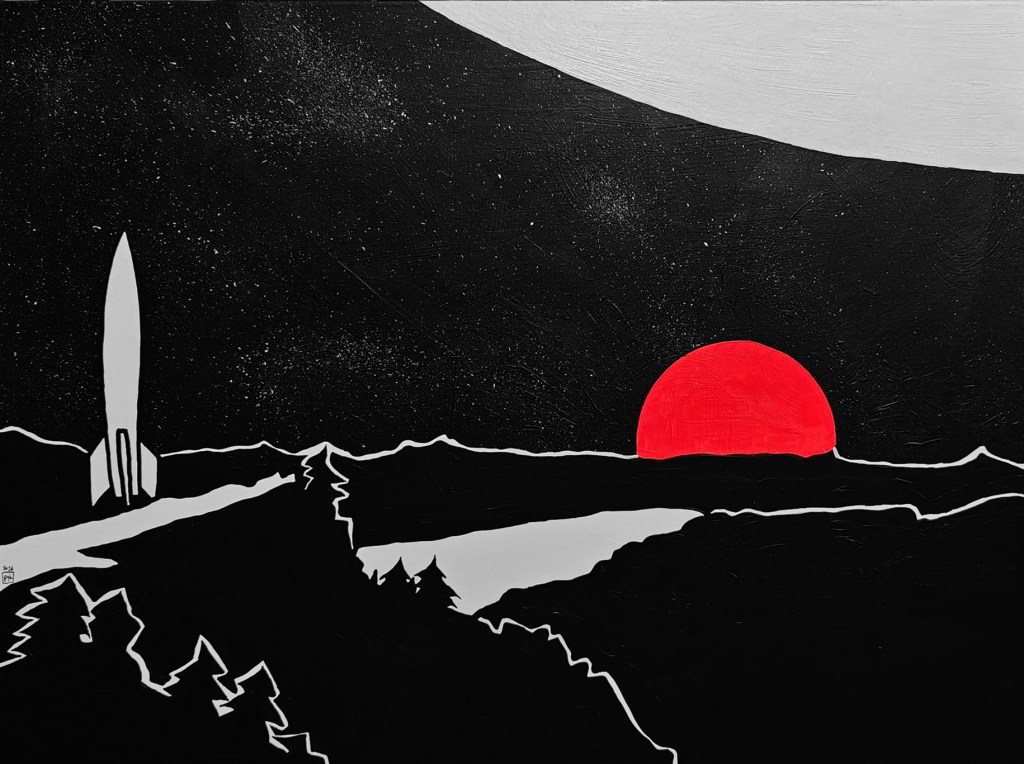
Etape aux confins
Toile 60 x 80 cm
Peinture acrylique noire, blanche et rouge
Novembre 2026
Exposée à l’atelier depuis l’hiver 2026
L’univers est grand, tellement vaste que c’en est inconcevable. Et si la traversée d’une galaxie est déjà terriblement longue, les 150’000 années lumières de notre voie lactée ne sont rien en comparaison de la distance à la galaxie la plus proche. Andromède se situe à 2,55 million d’années lumières du soleil. D’un diamètre d’environ 220’000 années-lumière, elle contiendrait environ mille milliards d’étoiles, deux à cinq fois plus que notre galaxie. Avec une magnitude visuelle de 3,4, la galaxie d’Andromède est l’une des rares galaxies observables à l’œil nu depuis la Terre dans l’hémisphère nord.
Le parsec est une des unités de longueur utilisée en astronomie. Il est défini comme valant environ 3,26 années-lumière. Le kiloparsec (kpc) vaut 1 000 parsecs donc environ 3 262 années-lumière. On utilise généralement le kiloparsec pour exprimer les distances entre différentes parties d’une galaxie ou au sein d’un groupe de galaxies. La voie lactée fait donc 45,98 kpc et Andromède se situe à 781,73 kpc. A la vitesse d’une fusée lunaire actuelle (40’000 km/h). Atteindre le soleil qui se situe à 150 millions de kilomètres de la terre prendrait 156 jours. Traverser la galaxie à la même vitesse prendrait 4 milliards d’année et atteindre Andromède presque 67 milliards d’année (!!)
Et que pensent les explorateurs au bord de ce grand vide? A contempler l’horreur de la noirceur de l’espace intergalactique avant de s’élancer vers la nébuleuse d’Andromède, on sent l’insignifiance de l’homme et l’on recherche le contact humain. Les planètes des confins sont la dernière étape avant le grand saut et toute une série de mondes sont ainsi devenus les derniers bastions de l’humanité avant de s’élancer vers l’inconnu.
La peinture illustre un de ces exportateurs du futur posé sur une de ces planètes « des derniers contacts ». Dans quelques heures elle s’envolera vers son destin…
A Stop at the Edge
Canvas, 60 x 80 cm
Black, white and red acrylic paint
November 2026
On display in the studio since winter 2026
The universe is vast, so vast as to be inconceivable. And whilst travelling across a galaxy is already an incredibly long journey, the 150,000 light-years of our Milky Way are nothing compared to the distance to the nearest galaxy. Andromeda lies 2.55 million light-years from the Sun. With a diameter of approximately 220,000 light-years, it is thought to contain around one thousand billion stars – two to five times more than our own galaxy. With a visual magnitude of 3.4, the Andromeda Galaxy is one of the few galaxies visible to the naked eye from Earth in the northern hemisphere.
The parsec is one of the units of length used in astronomy. It is defined as being approximately 3.26 light-years. The kiloparsec (kpc) is equal to 1,000 parsecs, or approximately 3,262 light-years. The kiloparsec is generally used to express distances between different parts of a galaxy or within a group of galaxies. The Milky Way is therefore 45.98 kpc across, and Andromeda is situated 781.73 kpc away. Travelling at the speed of a modern lunar rocket (40,000 km/h), it would take 156 days to reach the Sun, which is 150 million kilometres from Earth. Travelling across the galaxy at the same speed would take 4 billion years, and reaching Andromeda would take almost 67 billion years (!!)
And what do the explorers think as they stand on the edge of this vast void? As they contemplate the horror of the darkness of intergalactic space before setting off towards the Andromeda Nebula, they feel the insignificance of humankind and yearn for human contact. The planets on the frontier are the final stop before the great leap, and a whole series of worlds have thus become humanity’s last bastions before venturing into the unknown.
The painting depicts one of these ‘explorers of the future’ standing on one of these ‘last contact’ planets. In a few hours, she will set off towards her destiny…


Votre commentaire